The people are the platform.
Instagram was built on something deeply human.
It was built on the impulse to share a moment, a feeling, a place, a photograph, a piece of ourselves. It gave people a way to be seen. It helped strangers find one another. It let artists, photographers, small businesses, storytellers, and everyday people create little corners of connection in a very large world.
That is why I believe Instagram will eventually fail.
Not necessarily overnight. Not necessarily in some dramatic collapse where everyone vanishes at once. It may remain enormous for years. It may continue to have money, influence, advertisers, technology, and billions of pieces of content flowing through its systems every day.
But I believe it is slowly weakening the very foundation that made it matter.
Because Instagram has removed too much humanity from a platform that was supposed to celebrate humanity.
A platform about people should have people at its center
Somewhere along the way, the relationship changed.
Creators and users once felt like participants in a community. We shared our work, found our audience, learned from one another, and built genuine relationships. The platform was imperfect, of course, but there was still a feeling that a human being existed somewhere behind the curtain.
Now, too often, it feels like there is only a machine.
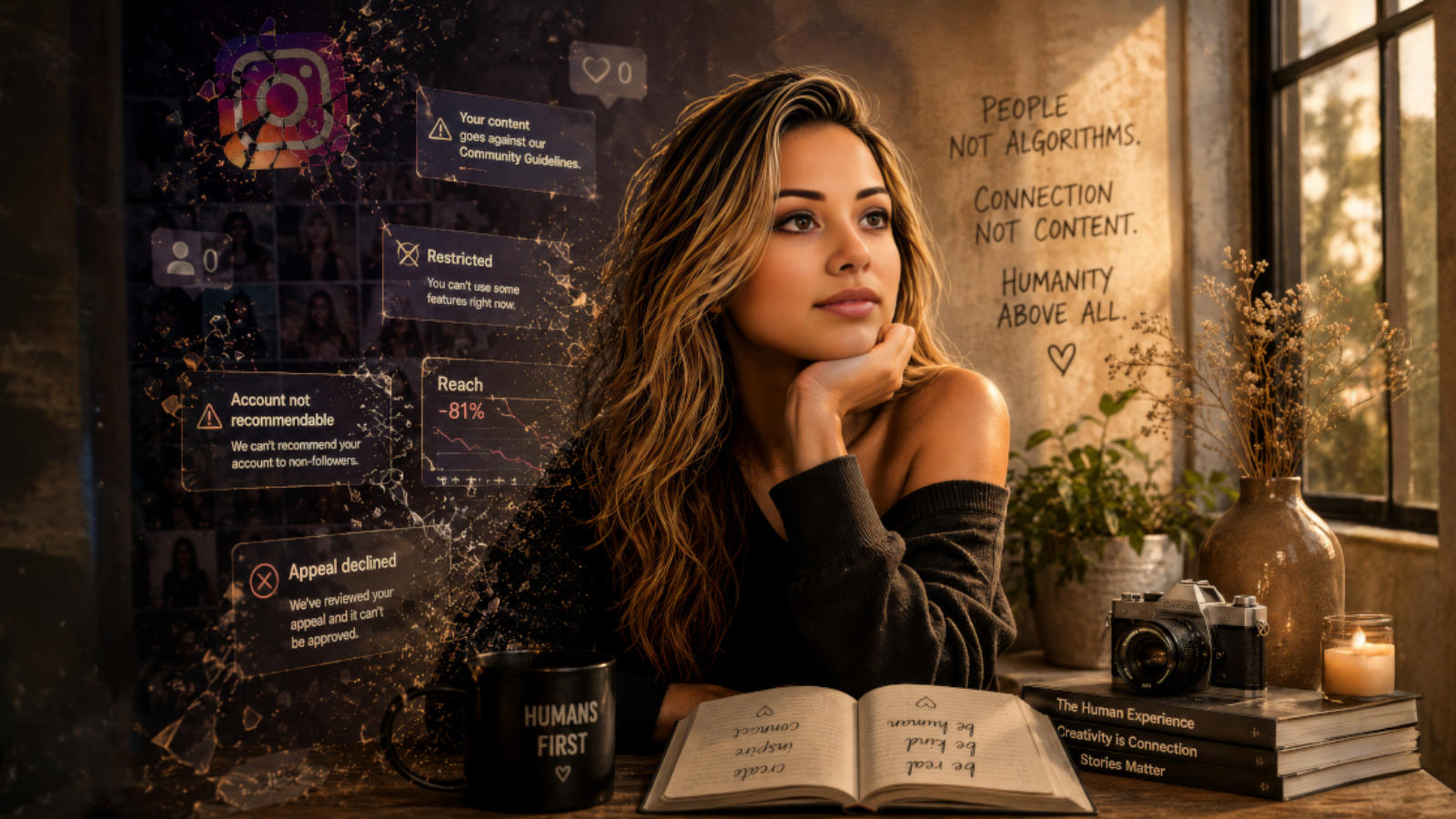
Accounts are restricted. Content disappears. Reach collapses. Features change. Recommendations shift. People are told that their work violates a rule they cannot clearly understand, enforced by a system they cannot speak to, with an appeal process that may never involve a meaningful human review.
And that is the problem.
Automation can be useful. Technology can help a platform operate at scale. Algorithms can assist with safety, moderation, spam prevention, and discovery.
But technology should support people.
It should not replace accountability, empathy, judgment, or the basic human dignity of being heard.
When a creator loses access to an audience they spent years building, there should be a real person available to explain why. When an automated system makes a mistake, there should be a meaningful way to correct it. When someone is trying to follow the rules in good faith, they should not feel like they are pleading with a locked door.
Technology is not the community
Instagram’s technology is powerful.
Its systems can identify trends, predict engagement, personalize feeds, filter content, detect possible violations, and decide what millions of people see every day. But none of that technology is the reason Instagram became valuable.
The value was always the people.
It was the photographer posting their first beautiful image. The artist finding someone who understood their work. The small business owner reaching a customer across the country. The person sharing a difficult day and receiving kindness from someone they had never met. The creator who spent years learning, improving, showing up, and giving their audience something meaningful.
Algorithms did not create that culture.
Humans did.
The platform may own the servers, the code, the data, and the distribution system. But it does not own the trust, creativity, loyalty, or emotional investment that people bring to it. Those things have to be earned continuously.
And once they are lost, they are very hard to get back.
When people become inputs instead of partners
What worries me most is the feeling that creators and users are no longer treated as partners in the platform’s success.
Instead, we can start to feel like inputs.
We create the content. We provide the attention. We generate the engagement. We keep the platform active, interesting, and culturally relevant. We give people reasons to open the app.
Yet too often, the people doing that work are met with silence, confusion, and instability.
A creator can do everything they are told to do. They can make better content, stay within the rules, engage authentically, avoid risky behavior, and still watch their visibility disappear without a clear explanation.
That does not build trust.
It creates fear.
And fear is not a sustainable foundation for a creative community.
People may stay because their audience is there. They may stay because rebuilding elsewhere feels overwhelming. They may stay because they have invested too much time to simply walk away.
But eventually, many people leave emotionally before they leave physically.
They stop believing the platform is on their side.
They stop trusting that effort will be recognized fairly.
They stop feeling inspired to create.
And once that happens, the platform may still look busy from the outside, but something important has already begun to die.
A company cannot out-automate human connection
A platform centered on human expression cannot succeed forever by treating humanity as an inconvenience.
It cannot rely entirely on systems that make decisions without context. It cannot build loyalty while making people feel disposable. It cannot celebrate creativity while making creators feel powerless. It cannot claim to build community while removing every meaningful path to a real conversation.
Technology can scale moderation.
Technology can organize information.
Technology can make recommendations.
But it cannot replace compassion.
It cannot replace fairness.
It cannot replace the simple but essential experience of feeling that someone listened.
Instagram may continue to evolve. It may introduce more tools, more AI, more automation, more ways to optimize attention and engagement. But none of those things will matter if the people using it increasingly feel unseen, unheard, and undervalued.
Because technology is not the community.
Algorithms are not culture.
Automation is not trust.
The people are the platform.
And when a company values its systems more than the humans those systems are supposed to serve, it may remain powerful for a while. But eventually, it loses the loyalty, creativity, and belief that made it powerful in the first place.
Instagram may still have the technology, the scale, and the money.
But without humanity at its core, it will eventually lose the very people who gave it meaning.
I wish it would change. But I don’t think it will. At least not with the current management.
I think you are right, Mishelle. It is so unfortunate that it is the way it is.