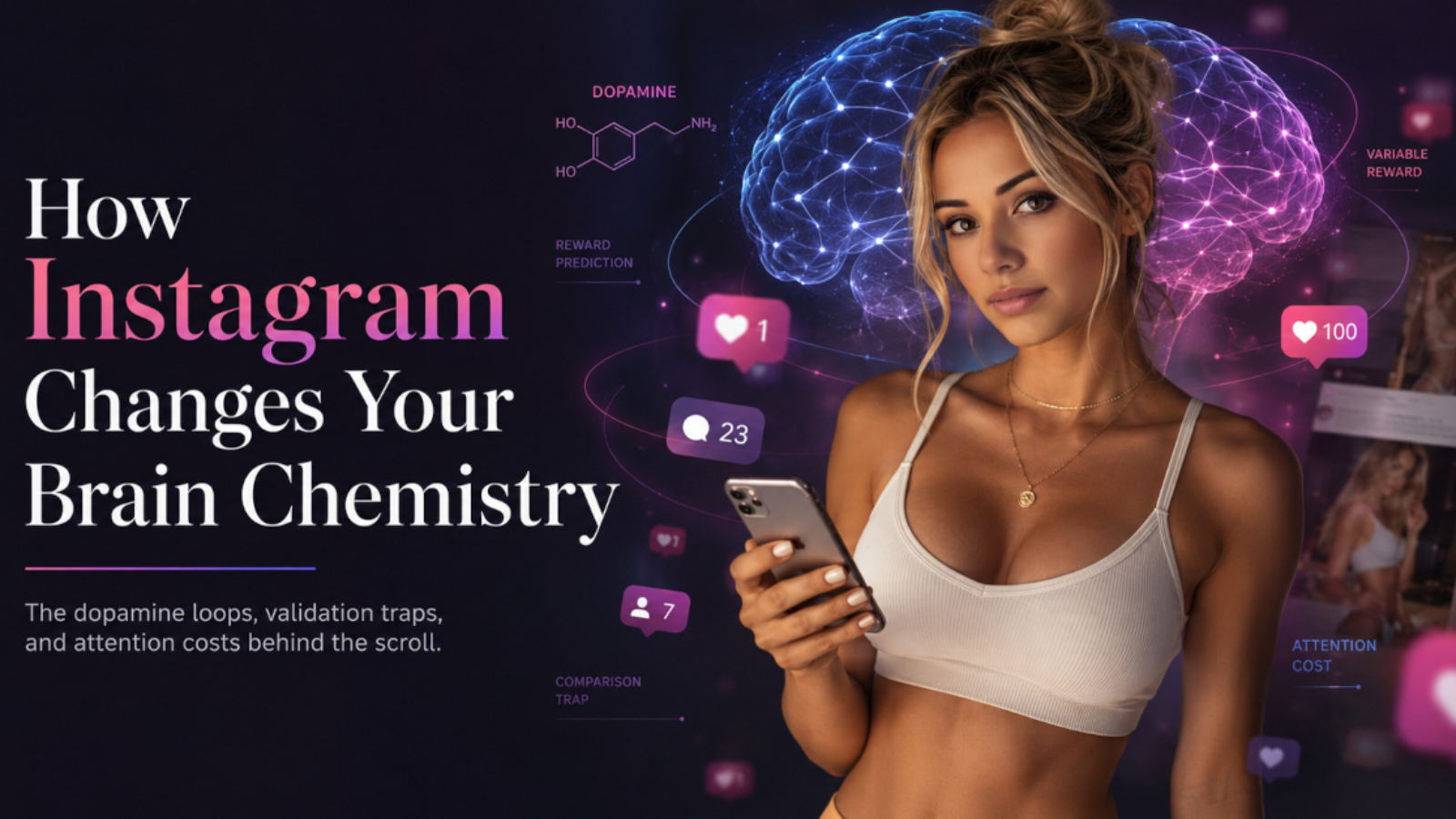
And Why It Can Feel So Hard to Walk Away
There is a strange thing that happens when you spend enough time on Instagram.
You open the app for “just a minute.” You check a post. You look at the likes. You refresh. You answer a comment. You check a Story view. You scroll. You compare. You wonder why one post worked and another one disappeared into the void.
And somehow, five minutes becomes thirty.
The uncomfortable truth is that this is not just a lack of discipline. Instagram is designed around reward loops that interact with the brain’s motivation, attention, and emotional regulation systems. The app does not simply show us pictures. It trains us to anticipate feedback.
That anticipation is where the chemistry begins.
Dopamine Is About Wanting, Not Just Pleasure
Most people think dopamine is the “pleasure chemical,” but that is only part of the story. Dopamine is deeply tied to motivation, anticipation, and learning. It helps the brain notice what might be rewarding and pushes us to repeat behaviors that seem likely to give us a reward again.
Instagram understands this beautifully.
A like, a comment, a new follower, a Story reaction, a post suddenly taking off — these things do not arrive in a predictable pattern. Sometimes you get nothing. Sometimes you get a tiny spark. Sometimes a post surprises you and performs better than expected.
That unpredictability is powerful.
It is similar to the psychology behind slot machines. The reward is not guaranteed, and because it is not guaranteed, the brain keeps checking. Maybe this refresh will show something. Maybe this post is finally moving. Maybe someone important saw it. Maybe the algorithm will smile on me today.
That “maybe” is addictive.
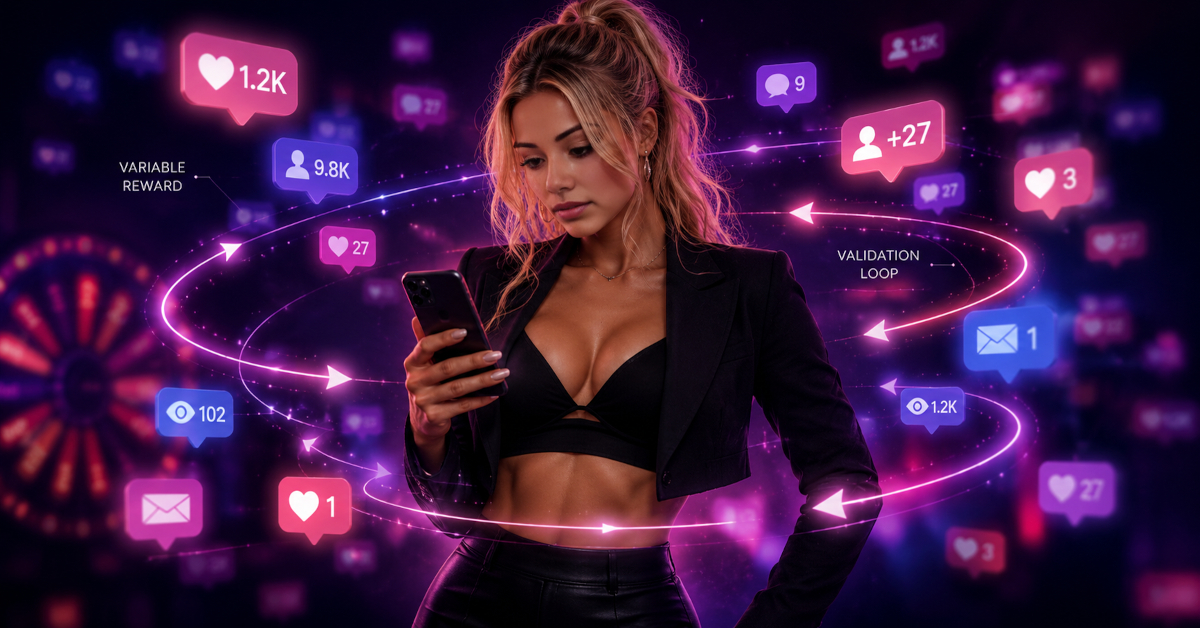
The Variable Reward Trap
Instagram’s reward system is built on variable reinforcement. You do not know exactly when the reward will arrive, how big it will be, or whether it will arrive at all.
That uncertainty keeps the loop alive.
A predictable app would be easier to put down. If every post received the same number of likes at the same time, the emotional charge would fade. But Instagram does not work that way. It gives enough reward to keep you invested, enough silence to make you anxious, and enough randomness to make you keep trying.
For creators, this can become especially intense.
You are not only scrolling. You are monitoring your value in public. Every post becomes a little test. Every dip in engagement feels personal. Every spike feels like oxygen.
That is a brutal way to train the nervous system.
When Validation Becomes a Feedback Loop
Likes and comments are not meaningless. Humans are social creatures. We are wired to care about connection, approval, belonging, and recognition.
Instagram turns those ancient social needs into visible numbers.
A post does well, and you feel seen. A post flops, and you feel rejected. Someone comments something kind, and your mood lifts. Someone disappears, unfollows, or ignores you, and it can sting more than you want to admit.
Over time, the brain can start connecting emotional safety with digital feedback.
That is when the app stops being entertainment and starts becoming a mirror you keep asking, “Am I okay?”
The problem is that Instagram is not a fair mirror. It is an algorithmic environment shaped by timing, competition, platform incentives, invisible restrictions, trends, and random chance. But emotionally, it can still feel like a judgment.
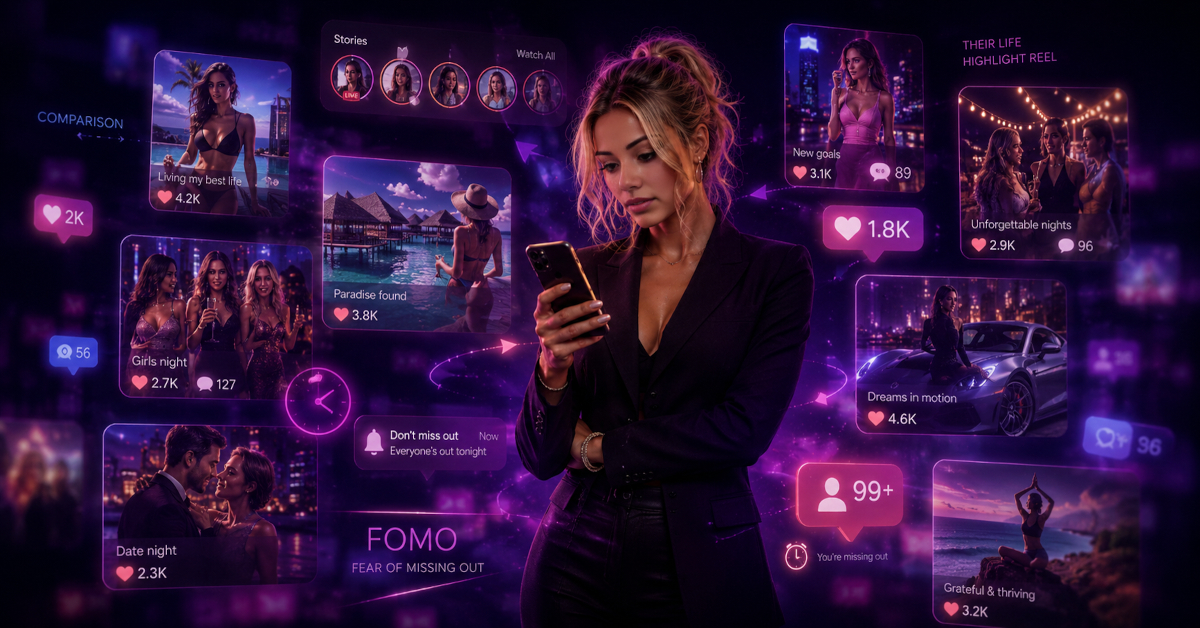
Comparison Is Built Into the Feed
Instagram is also a comparison machine.
You see the best image from someone’s best angle in their best light on their best day. You see vacations, bodies, relationships, outfits, homes, meals, confidence, beauty, success, and attention — all compressed into a perfect little scroll.
Even when you know it is curated, your brain still reacts.
Comparison can quietly lower your sense of self-worth. It can make normal life feel dull. It can make your own body, work, creativity, or relationships feel less impressive than they actually are.
And for creators, comparison is not only visual. It is numerical.
Their post got more likes.
Their Reel reached more people.
Their account is growing faster.
Their audience seems more loyal.
Their life looks easier.
That kind of comparison does not inspire for long. Eventually, it exhausts.
FOMO Keeps You Coming Back
Fear of missing out is another part of the loop.
You check because something might be happening. Someone might have messaged. A trend might be taking off. A post might need a reply. A follower might be slipping away. The algorithm might punish silence. The conversation might move on without you.
FOMO makes rest feel risky.
That is one of the cruelest parts of social media. Even stepping away can feel like losing ground. The app creates the sense that you must remain present, responsive, and visible, even when your mind is begging for quiet.
Attention Gets Trained in Fragments
Instagram also changes how attention feels.
The app rewards quick scanning. A second here. A swipe there. A half-read caption. A flash of beauty. A burst of outrage. A funny Reel. A notification. A comment. Another swipe.
The brain adapts to that rhythm.
After enough time in fast, fragmented environments, slower things can begin to feel strangely difficult: reading, writing, praying, listening, creating, having a deep conversation, or simply sitting with your own thoughts.
It is not that you have lost the ability to focus forever. It is that your attention has been trained to expect constant novelty.
Deep focus feels quiet. Instagram feels electric.
And once the brain gets used to electric, quiet can feel like boredom.
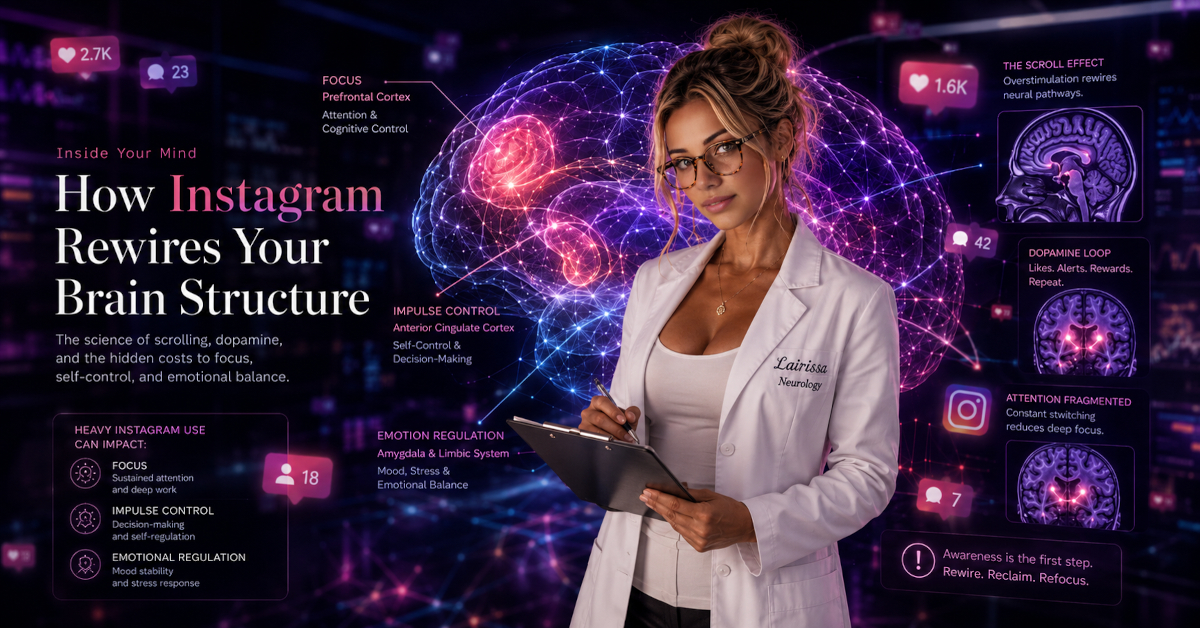
What About Brain Structure?
Some research suggests that problematic social media use may be associated with differences in brain areas involved in reward processing, impulse control, emotional regulation, and attention. That does not mean Instagram magically damages everyone’s brain. The science is more careful than that.
But it does suggest something important: heavy, compulsive use is not just a “bad habit.” It may reflect real changes in how the brain responds to cues, rewards, urges, and self-control.
In plain language, the more we practice checking, comparing, refreshing, and reacting, the easier those behaviors become. The brain gets better at what it repeatedly does.
That can work for us.
It can also work against us.
The Emotional Cost
For some people, Instagram is harmless fun. It is inspiration, connection, creativity, and community.
But for others, especially heavy users and creators, the emotional cost can grow quietly.
You may notice:
You feel anxious when you have not checked the app.
You feel low after scrolling.
You compare your body, beauty, success, or life to others.
You keep refreshing even when nothing good is happening.
You feel more irritable, distracted, or emotionally fragile.
You struggle to enjoy creating unless it performs well.
You feel like your worth rises and falls with engagement.
That is not weakness.
That is a human nervous system reacting to a machine built to keep attention
The 30-Minute Lesson
One of the most interesting studies on this topic came from the University of Pennsylvania. Researchers found that limiting Facebook, Snapchat, and Instagram use to about 30 minutes per day led to significant reductions in loneliness and depression over several weeks compared to normal use.
That does not mean everyone has to quit social media.
But it does suggest that boundaries matter.
The goal may not be to disappear completely. The goal may be to stop letting an app set the emotional temperature of your day.
A Healthier Relationship With Instagram
If Instagram has started to feel heavy, the answer is not always dramatic. Sometimes small boundaries can make the nervous system breathe again.
Try checking at set times instead of constantly.
Turn off nonessential notifications.
Post, then step away.
Do not refresh a new post for the first hour.
Mute accounts that trigger comparison.
Separate creating from performing.
Spend part of the day in places where no one can like, rank, or judge you.
Let your brain remember what quiet feels like.
Most importantly, notice how the app makes you feel.
Not how it makes you look.
Not how it makes your account perform.
Not how it makes other people respond to you.
How it makes you feel.

The Real Question
Instagram can be beautiful. It can be fun. It can connect people who never would have found each other otherwise. It can give artists, models, writers, small businesses, and creators a place to be seen.
But it can also train us to crave constant stimulation, constant approval, and constant comparison.
That is the part worth questioning.
Because your mind was not made to be refreshed every thirty seconds.
Your creativity was not meant to be measured only by engagement.
Your worth was never supposed to depend on whether an algorithm decided to show you to people today.
Sometimes the healthiest thing we can do is step back, take a breath, and remember that we are more than the numbers blinking back at us from a screen.
Sources & Further Reading
Hunt, M. G., Marx, R., Lipson, C., & Young, J. (2018). “No More FOMO: Limiting Social Media Decreases Loneliness and Depression.” Journal of Social and Clinical Psychology.
This University of Pennsylvania study found that limiting Facebook, Snapchat, and Instagram use to about 30 minutes per day led to significant reductions in loneliness and depression over three weeks.
https://guilfordjournals.com/doi/10.1521/jscp.2018.37.10.751
University of Pennsylvania. “Social media use increases depression and loneliness.” Penn Today, November 9, 2018.
A plain-language summary of the Penn study on limiting social media use and its effects on well-being.
https://penntoday.upenn.edu/news/social-media-use-increases-depression-and-loneliness
Schultz, W. (2016). “Dopamine reward prediction error coding.” Dialogues in Clinical Neuroscience.
Explains how dopamine is connected not only to pleasure, but also to reward prediction, anticipation, learning, and motivation.
https://pmc.ncbi.nlm.nih.gov/articles/PMC4826767/
Lerner, T. N., Holloway, A. L., & Seiler, J. L. (2020). “Dopamine, Updated: Reward Prediction Error and Beyond.” Current Opinion in Neurobiology.
A modern overview of dopamine’s role in reinforcement learning, prediction error, and reward-related behavior.
https://pmc.ncbi.nlm.nih.gov/articles/PMC8116345/
Dores, A. R., et al. (2025). “The Effects of Social Feedback Through the ‘Like’ Feature on Brain Activity: A Systematic Review.”
A systematic review of research on how online social feedback, especially likes, is associated with measurable brain activity using fMRI and EEG studies.
https://pmc.ncbi.nlm.nih.gov/articles/PMC11719588/
Wadsley, M., Ihssen, N., & Bilderbeck, A. C. (2023). “A Systematic Review of Structural and Functional MRI Studies Investigating Social Networking Service Use.”
Reviews MRI research on social networking use and problematic or compulsive SNS use, including associations with reward, attention, and emotional regulation systems.
https://pmc.ncbi.nlm.nih.gov/articles/PMC10216498/
Montag, C., et al. (2023). “Neuroimaging the effects of smartphone (over-)use on brain function and structure — a review on the current state of MRI-based findings.”
A review of MRI studies examining excessive smartphone use and its possible associations with brain structure, brain function, mental health, and cognitive-emotional processes.
https://pmc.ncbi.nlm.nih.gov/articles/PMC10917376/
Servidio, R., et al. (2024). “Fear of missing out and problematic social media use: A serial mediation model of social comparison and self-esteem.”
Explores how fear of missing out may contribute to problematic social media use through social comparison and self-esteem.
https://pmc.ncbi.nlm.nih.gov/articles/PMC10943642/
Steinberger, P., et al. (2023). “Social comparison of ability and fear of missing out mediate the relationship between subjective well-being and social network site addiction.”
Examines the connection between social comparison, FOMO, subjective well-being, and problematic social networking behavior.
https://pmc.ncbi.nlm.nih.gov/articles/PMC10332318/
Naslund, J. A., Bondre, A., Torous, J., & Aschbrenner, K. A. (2020). “Social Media and Mental Health: Benefits, Risks, and Opportunities for Research and Practice.” Journal of Technology in Behavioral Science.
A broader review of both the potential benefits and risks of social media use, including social comparison, mental health concerns, and opportunities for healthier digital habits.
https://pmc.ncbi.nlm.nih.gov/articles/PMC7785056/
So very true