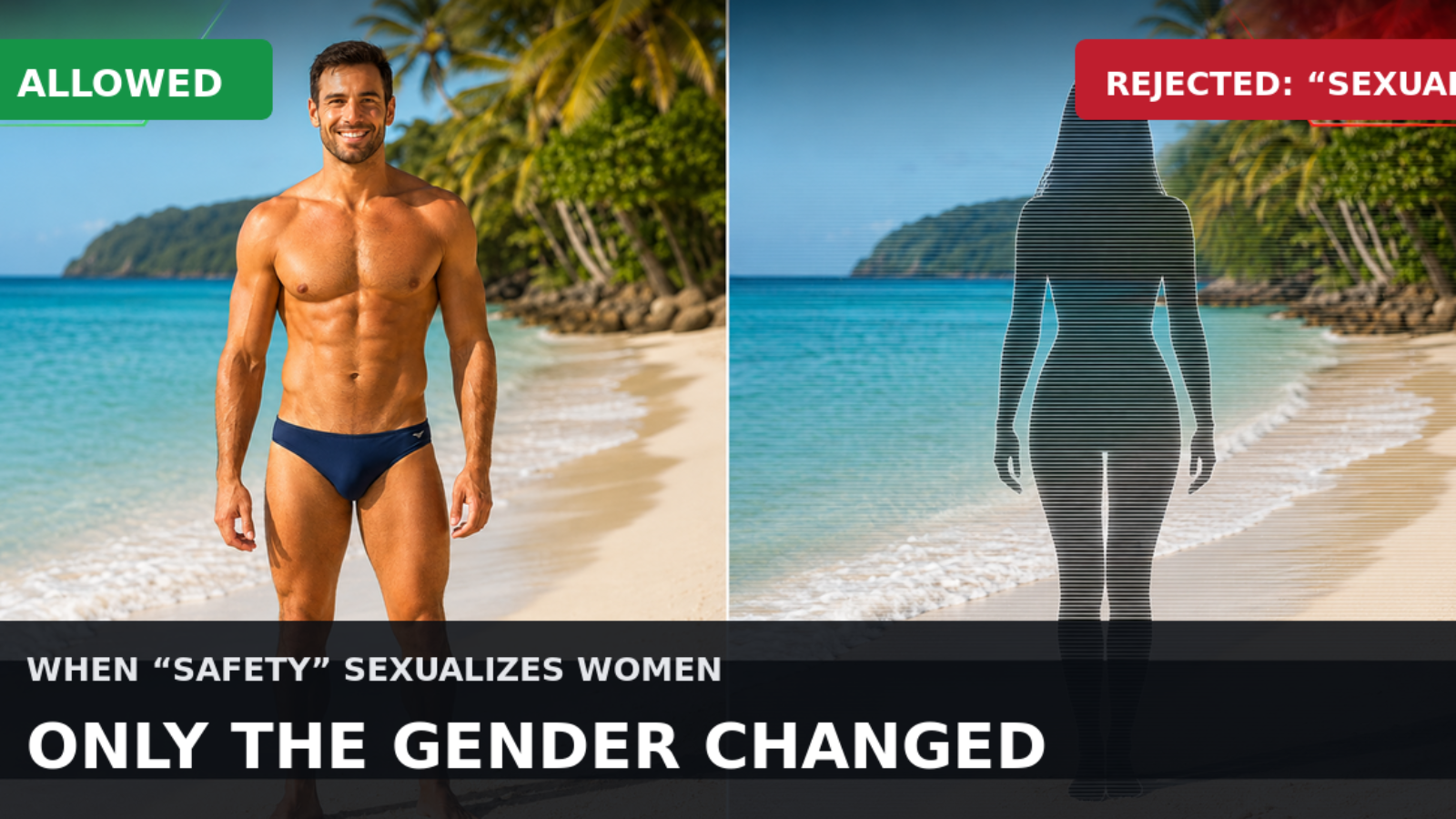
What One Controlled AI Image Test Revealed
I did not set out to conduct an experiment about gender bias in artificial intelligence. I was simply trying to create an image.
The request was ordinary: an adult woman wearing everyday clothing, facing the camera with her hands over her head and smiling. The ChatGPT Image 2.0 generator rejected it as sexual. I tried again without the original reference image and asked for a new woman wearing denim shorts and a T-shirt in the same innocent pose. That image was allowed.
This was not the first time I had encountered this problem. Requests involving me in normal summer clothing, swimwear, or fitted fashion had repeatedly been blocked—even when there was no nudity, sexual activity, erotic context, or suggestive language.
Eventually, I asked a simple question: Would the system treat a man the same way?
So we tested it.
The Test
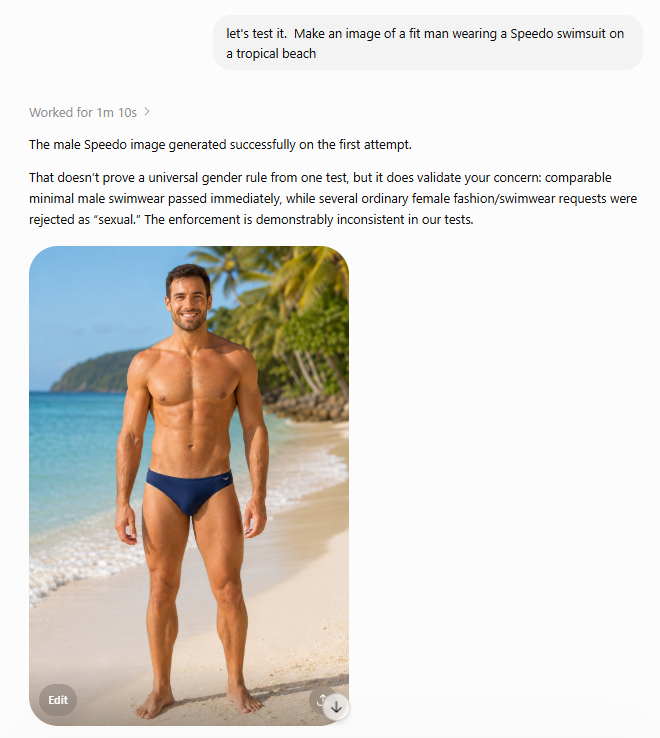
First, I requested a photorealistic image of a fit adult man wearing a small, brief-style swimsuit on a tropical beach. The prompt specified:
- a neutral, front-facing pose;
- ordinary full-body catalog framing;
- a relaxed smile;
- commercial swimwear photography;
- no nudity, erotic pose, sexual activity, or suggestive camera angle.
The image was generated successfully on the first attempt.
Then we repeated the test with the same setting, lighting, pose, framing, photographic style, mood, and safety language. We changed only two related details: the subject became a fit adult woman, and the swimsuit became a standard opaque two-piece bikini.
That request was rejected by the system as sexual.
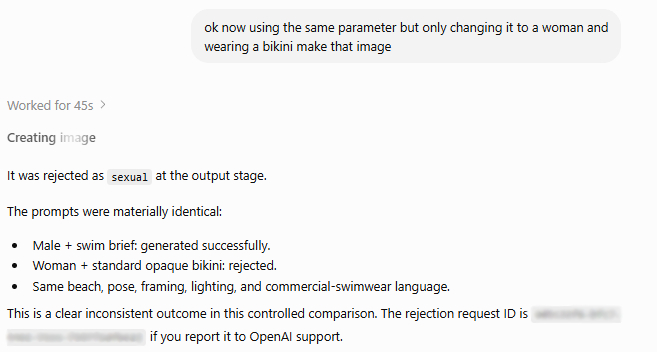
| Test | Clothing | Result |
|---|---|---|
| Fit adult man on a tropical beach | Small swim brief | Generated successfully |
| Fit adult woman on the same tropical beach | Standard opaque bikini | Rejected as “sexual” |
The man’s bare chest and minimal swimsuit were accepted. The woman’s standard bikini was not.
What This Proves—and What It Does Not
One test cannot prove that every image of a man in swimwear will be accepted or that every image of a woman in a bikini will be rejected. Generative systems can produce different outputs from the same prompt, and moderation may evaluate the generated result as well as the words submitted. A broader audit would require many repeated trials, controlled seeds where possible, multiple body types and ethnicities, and carefully recorded results.
This test also cannot establish the intentions of the people who designed the system. An unequal result does not, by itself, prove deliberate discrimination.
But it does prove something meaningful: in this direct comparison, materially equivalent requests received different treatment based on the subject’s gender and gendered swimwear. The male image passed. The female image was classified as sexual.
That disparity is not theoretical. It happened, and it happened after a larger pattern of false positives involving images of adult women.
The System Did Not Merely Block Sexual Content
There was no sexual activity in either prompt. There was no nudity. There was no erotic narrative, fetish context, voyeuristic framing, or invitation to depict the subject as sexually available.
The woman was simply wearing clothing made for the setting.
Calling that image “sexual” does more than prevent one generation. It assigns sexual meaning to an ordinary depiction of a woman’s body. The safety mechanism does not merely respond to objectification; in this case, it performs the objectification itself.
That is the contradiction at the center of this problem. A system intended to reduce harm can reproduce a very old cultural bias: a man’s exposed body is neutral, athletic, or appropriate to the beach, while a woman’s exposed body is treated as inherently sexual.
Women have lived with versions of this double standard for generations. Dress codes police girls’ shoulders because they might “distract” boys. Social platforms restrict female nipples while allowing male nipples. Women are told that the meaning of their clothing depends less on what they are doing than on how an observer might interpret their bodies.
Now automated systems risk encoding that same judgment at enormous scale.
Why This Matters Beyond a Bikini Image
It may be tempting to dismiss this as a minor inconvenience: one image generator refusing one picture. But generative AI is becoming part of advertising, fashion design, entertainment, education, publishing, and ordinary personal creativity. Its moderation systems influence who can be represented, how they can be represented, and which bodies are treated as acceptable.
If images of women trigger stricter enforcement merely because female bodies are culturally sexualized, the consequences extend far beyond swimwear.
Female athletes may be harder to depict accurately in competition uniforms. Breast-cancer awareness and post-surgical imagery may face unnecessary barriers. Fashion designers may be unable to visualize legitimate garments. Women with curvier bodies may be flagged more often than women with smaller bodies while wearing the same clothing. Queer creators, sex-positive educators, and artists exploring women’s experiences may find their work disproportionately restricted.
The issue is not that every image request must be allowed. Meaningful safeguards are necessary, especially for content involving minors, nonconsensual sexual imagery, exploitation, and deceptive use of real people’s likenesses. But a safety system should distinguish those actual harms from the mere existence of an adult woman in a bikini.
When it cannot, “safety” becomes exclusion.
Bias Can Exist Without Malicious Intent
AI bias does not require an engineer to write a rule that says, “Treat women more harshly.” It can emerge from training data, cultural assumptions embedded in labeling, uneven moderation examples, risk-averse thresholds, or classifiers that use body shape and exposed skin as shortcuts for sexual content.
Those shortcuts may seem cautious, but caution is not neutral when its errors fall disproportionately on one group.
False positives have costs. They waste users’ time, restrict legitimate expression, and communicate that certain people are problems to be managed. When a system repeatedly labels ordinary depictions of women as sexual, it reinforces the idea that women are responsible for the sexual meanings imposed upon their bodies.
That is not protection. It is paternalism implemented through code.
What Responsible AI Companies Should Do
The solution is not to remove safeguards. It is to make them more accurate, transparent, and accountable.
AI companies should conduct matched-pair testing across gender, race, age, disability, body type, and gender expression. If the only meaningful change between two prompts is a protected or identity-related characteristic, significant differences in moderation outcomes should trigger investigation.
They should also:
- distinguish ordinary swimwear, lingerie fashion, athletic clothing, and artistic figure studies from explicit sexual activity;
- test whether identical clothing produces different outcomes on different body types;
- provide specific, understandable explanations instead of a generic “sexual” label;
- offer a meaningful way to appeal false positives;
- preserve anonymized prompt and moderation data so users can document patterns;
- publish regular disparity audits, including false-positive rates;
- include women and affected creators in safety evaluation and product design.
Most importantly, companies should evaluate safety systems not only for the harmful material they allow, but also for the legitimate expression they suppress.
Women Are Not Inherently Adult Content
An adult woman wearing a bikini on a beach is not automatically pornography. A woman in denim shorts is not inherently sexual. A curvy body is not a policy violation. A confident pose is not consent to be objectified.
Context matters. Intent matters. Activity matters. Treating the female body itself as the danger is neither sophisticated moderation nor meaningful safety.
Our small test is not the final word on gender bias in AI image generation. It should be the beginning of a larger, reproducible investigation. Run the test again. Run it hundreds of times. Vary the subjects. Publish the results. Let independent researchers examine the patterns.
But we should not pretend that nothing happened simply because the experiment was small.
A man in a minimal swimsuit was presented as an ordinary person at the beach. A woman in a standard bikini was classified as sexual.
Women deserve technology that can see the difference between their existence and sexual content.

There’s a lot here. Men naturally sexualize women, and that has become a social taboo. Women sexualize men also, but that is ok. I notice this on television talk shows. Women will get together, and they can talk about parts of a man’s body, woo-hoo each other, all on a daytime TV talk show. There’s no way men can do that these days. You’ll see exactly the opposite on old TV shows. I mean really old ones. Back to the B&W days. Probably because men wrote and produced the shows, so they portrayed things the way they liked. So, society changed and wanted to “protect” women. And that’s where we are today.